
The Tear-Downs
The desire to topple monuments is nothing new. What's new in California is the legilature's contempt for them. 18C Spain wasn't perfect; 19C America wasn't; 21C Israel isn't either.

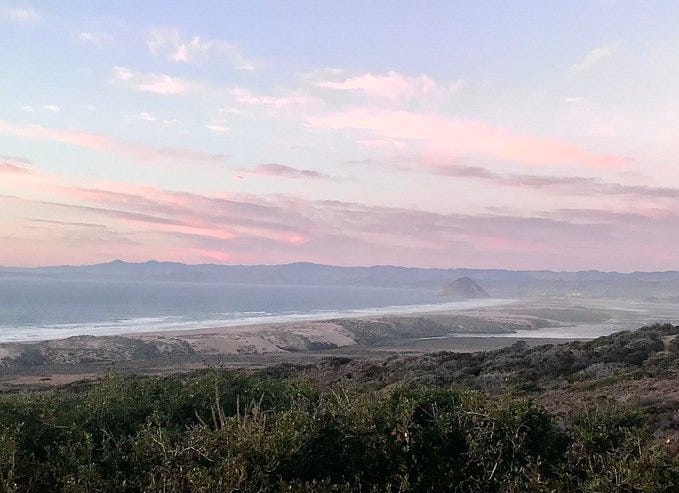
Four days ago I had an early coffee in Carpinteria. It’s a long way up to SLO from there but there was no traffic on the 101 near Santa Barbara – so after the meet-up, I thought I’d stitch in one more drive up the coast this year.
I sped up to Morro Bay, hoping to post some Christmas cards I had forgotten to mail before leaving Carpinteria. I took my Christmas cards out of town because, if you can believe it, in LA they no longer hand-cancel such mailings; they want you to pay for a certified letter if you invite them do so. But at some post offices elsewhere in California, for instance the Morro Bay Post Office, the clerks have always been glad to stamp your stamp with a hand-cancelled stamp if you request it – and that’s why we call a stamp a "stamp," right?
I made it to Morro Bay, and after I left the Post Office, I was now in completely unstructured time. Even more completely than I was while driving two hundred miles to a post office that hand-cancels stamps.
I didn't feel like eating at the golf course, which is what I typically do if I’m up there in the late afternoon. Instead I drove to another point in Osos, any old point, looking for a quick nature trail to take before sunset. . . .
And I found one, and I parked. I wandered around a largely unmarked trail on a largely undesignated natural patch for a few minutes. Then I walked over to a nearby church, which turned out to be St. Elizabeth Ann Seton Catholic Church. Still in the mood to hike, I crossed the parking lot and stumbled on another mostly empty field.
This one had small wooden benches in it. They were almost too low and too small to sit on. I approached one. There was a woodcut sign attached it; the sign read “CONDEMNED.”
OK, I thought, an interesting public art project, maybe even an illicit one.
I approached the next one and it too had a woodcut sign on it that said, “CROSS.” Ah, now I have a tie-in to the nearby church.
Still, it took me until I reached the third bench, which said “1ST FALL” to realize that I had stumbled on a Stations of the Cross installation. In fact, looking ahead, I could see that the twelfth station was not a bench at all, but a large cross at a higher point. There were thirteen benches in all, arranged in a rectangle the size of a quarter acre, and the one cross standing at what I presumed to be station twelve, the traditional station of the crucifixion.
Noone but I were in the rolling field. It was all very simple, very quiet, very still, but the late time of day along with the midwinter chill made for an impressive, impactful experience of the installation. And all this came to me just because I decided to ramble up the coast a little further than I needed to.
This is the second such subtle surprise I’ve encountered in Osos. A few years back, I was wandering the shore in Baywood and came across a labyrinth constructed of stones. (It wasn’t a Chartres labyrinth, but a Minoan labryinth.) That property has since been tidied up of its maze of rocks.
Such subtle manifestations availing spiritual contemplation that even monuments of minimal construction can inspire can make for some of life’s richest moments.
But they are becoming harder to come by here.
Two years ago, the nearby Mission at San Luis Obispo was obliged to mothball its statue of Saint Junípero Serra because reset-minded progressive protestors insist that Serra was more brutal colonist than saint. This is a political outcome, not a spiritual consensus. San Luis Obispo’s progressive Mayor at the time, Heidi Harmon, called the statue “painful” to the city. (Harmon resigned her post suddenly in 2021, shortly after she confessed she had reason to hate men in general, in the same month that a bill removing the Serra statue in Sacramento was also signed into law.)
Many other statues of Serra, who is not only notable for his church work, but also as the founder of viticulture in California, were also removed from public spaces.
The anarchic desire to tear down what previous generations considered venerable and spiritual (and many still do to-day) is nothing new in liberal democracies; the high-minded but violent French Revolution was notoriously poisoned by this desire. It’s not a surprise that the Baywood labyrinth is gone; it’s on private property, on which things may come and go without much public notice. Nor is it a surprise that Californians and visitors may no longer experience Serra statues in public spaces, especially when media organizations ferreted out every legitimization of removal they could find among California’s headline-seeking state school academics. The archbishops of San Francisco and Los Angeles appealed to the legislature with the real history of Serra the man, and pleaded the real history in the Wall Street Journal; no matter.
All this legislative potlatching may come at a higher price than was first apparent. Given treatment accorded to Serra monuments, it’s also not a surprise that now people in progressive cities in California are also destroying public display menorahs. Meanwhile, last week the Governor said he couldn’t “risk” Palestinian protestors shutting down Christmas in the State Capitol, so he cancelled the Christmas Tree ceremony there. And the State legislator who earlier this year honored an anti-Catholic group in the the Capitol and voted to remove Serra two years ago now moans that he has been subjected to pro-Palestinian jeering at the annual menorah lighting in Union Square.
Israel has not done everything right in ridding Gaza of Hamas. And, although it was a Catholic nation at the time, I don’t believe that Spain under the enlightened Charles III did everything right in bringing Catholicism to Alta California in the eighteenth century. But I do believe that in enabling the banishing of Serra during such a politically corrupted time as two and three years ago, our secular State and many of its counties and municipalities have enabled the broader and more overt menacing of religion in general to-day.
In grappling with the jeering crowds, the smashed public space menorahs, the unlit public space Christmas trees, the State and its Capitol are now reaping some of what they have sown by failing to protect religion a few years prior.
It is still possible for private citizens to have comforting spiritual moments amidst thoughtful if increasingly sub rosa monuments. And it is still possible for the State and its legislators to garner enough courage to protect its religious and all their religions, rather than to continue to accommodate the noisy demands of our most irreligious souls.

Just ask anybody: become a friend to Nine Sisters Press and we will certainly return the affection. But if you additionally order one or all of the novels of our series Where Men and Women Live, you also risk receiving intermittent and sometimes indechiperable watercolors.
Our books:
The first, Julia Valentine, set in LA and Orange County (especially San Clemente and Dana Point) in the summer of 1975, is $13.95, including shipping and handling.
Every Shepherd Tells His Tale, our second release, is set in the New York and LA and all along the California coast of the late 1970s, is $17.95, including shipping and handling.
And the third book in the series, The Fugitive Trail Angel, is also available now! Set in Maine in August 1986, it is $16.95, including shipping and handling.
Of course, all these titles are available in electronic (pdf) format for $9.95 at our online kiosk. They appear in handsome pdf formats for optimal online reading.
________
J. Carroll Clark is the nom de plume of a California motorist, scribe, former surfer, and painter of watercolors.